Costa Rica visas in 2025: entry conditions, visa-free stays up to 180 days, minimum funds, immigration checks, fines and the risk of deportation for tourists
Are you planning a trip to Costa Rica, a winter getaway, or considering buying real estate here and looking for reliable information on entry conditions?
In November 2025, Costa Rica's General Directorate of Migration and Foreigners (in Spanish: Dirección General de Migración y Extranjería) issued new general visa guidelines for the entry and stay of non-residents. These regulations update previous rules and clearly define how Costa Rican visas work, the maximum length of stay, entry requirements, and border checks upon departure from the country.
Outdated information frequently circulates on the internet and social media, and my clients repeatedly ask me the same practical questions: whether they need a visa, how long they are allowed to stay, what funds they need to prove, and what happens if they overstay. That is why I have prepared a clear overview of the official immigration documents and the General Migration and Aliens Act No. 8764 (Ley General de Migración y Extranjería), explained in plain language for every traveler and investor.
WHO THIS ARTICLE IS FOR
This guide is designed particularly for those who:
- are planning a vacation or a multi-month stay in Costa Rica
- are looking for verified rules free of myths from online discussion forums
- want to invest in Costa Rican real estate or spend part of the year here as digital nomads or expats
- need to know exactly which documents, flight tickets, and financial resources immigration control at the airport requires.

1. WHO IS ELIGIBLE FOR VISA-FREE ENTRY AND UP TO 180 DAYS OF STAY
Costa Rica classifies foreign countries into four groups based on their visa regime:
- The Czech Republic, other European Union member states, the USA, Canada, the United Kingdom, Switzerland, Norway, and other selected countries fall into Group One.
- Citizens of these countries do not need a visa for tourism purposes.
- They may be granted an entry permit for up to 180 days.
- They must possess a valid passport in good condition, and the length of stay cannot exceed the validity of the passport.
The crucial point is that 180 days of stay is not an automatic legal right. The immigration officer at the airport decides individually based on the return tickets presented, accommodation bookings, and the overall context of your trip. In practice, many tourists receive a stamp for 30 to 90 days. A longer stay is possible, but the officer is under no obligation to grant it.
Countries classified under Groups 2, 3, and 4 (including parts of Latin America, Africa, and Asia) are subject to stricter rules, and their citizens require visas or special entry authorizations.
2. WHAT TOURISTS MUST FULFILL UPON ARRIVAL IN COSTA RICA
The new guidelines set out specific minimum requirements that foreigners must satisfy at border control:
- Valid passport: must be machine-readable or biometric and in flawless condition (free from tears, mechanical damage, or loose pages). For Group One citizens, validity throughout the entire planned stay in the country is sufficient.
- Visa: not required for tourist stays for citizens of the Czech Republic, EU, USA, or Canada.
- Proof of financial solvency: proof of at least USD 100 for each month or fraction of a month of the planned stay.
- Proof of onward travel: a return ticket, or an onward flight or transport ticket to another destination.
- No active entry bans: you must not have an active entry ban (in Spanish: impedimento de ingreso) in Costa Rica's immigration records, which typically results from a previous period of irregular stay.
3. FINANCIAL SOLVENCY: HOW MUCH MONEY YOU MUST DEMONSTRATE
Misunderstandings often arise regarding this requirement. A tourist must prove a minimum of USD 100 for each starting month of stay, not USD 100 per day.
This is the statutory minimum for border control, not a realistic travel budget for Costa Rica. Actual living expenses for accommodation, dining, transport, and services in the country are considerably higher.
Immigration regulations do not require you to present the entire sum in cash. They refer to solvency, meaning the ability to prove that you genuinely hold the funds. In practice, immigration officers accept:
- cash (ideally partially in USD, with the remainder in EUR exchangeable locally)
- an international debit or credit card
- if questioned further, a view of mobile banking showing the account holder's name and balance, or a bank statement.
Most travelers from the Czech Republic and other Group One nations are not questioned about finances directly, but the immigration officer possesses the legal authority to do so.
Read also
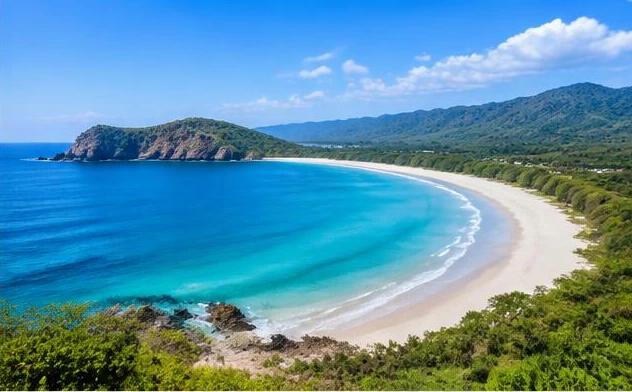
GUANACASTE, COSTA RICA AMONG FORBES “BEST PLACES TO VISIT IN 2026”
4. OVERSTAYING AND DIGITAL BORDER CONTROL
Some travelers remain in the country longer than their entry stamp permits, relying on informal advice claiming that immigration does not check. The law is unequivocal. Once the permitted period expires, the foreigner falls into irregular status (permanencia irregular). At that point, you are required to leave the country immediately or regularize your immigration status in good time. Every month of irregular stay carries a financial fine or a ban on re-entry.
Costa Rica operates a fully digitized system for tracking entries and departures. Upon arrival, you receive a passport stamp, and the system records the entry date along with the exact number of days granted. Upon departure, the officer scans the passport, and the system immediately displays the arrival date, the permitted length of stay, and any days spent in the country irregularly. If you respected the timeframe, you will pass through border control normally. If the limit was exceeded, the system automatically triggers penalty proceedings.
5. FIELD CHECKS AND DEPORTATION RISKS
Inspections do not take place solely at international airports. Police officers, in cooperation with immigration authorities, carry out random spot checks of identity and legal status inland and along main roadways.
I recall a situation involving a group of tourists, including two of our Czech friends, who came to Costa Rica for just three weeks. During their trip, they decided to visit Panama. When leaving Costa Rica at the land border crossing in Sixaola, they received a proper exit stamp. Sixaola is a specific border post with lighter tourist traffic, where the border consists of a pedestrian bridge and most people crossing are local Costa Ricans.
When returning to Costa Rica, however, a mistake occurred. The officer at the counter was watching a football match, failed to enter the travelers into the digital system, did not affix a new entry stamp, and simply waved them through with a gesture. A few kilometers down the road, a police patrol stopped their vehicle. During an ID check against the database, it emerged that the entire group was present in Costa Rica without a valid entry record, meaning illegally. Everyone was detained, escorted to a detention facility in San José, and subsequently deported from the country, even though they had not knowingly broken any rules.
"Costa Rican authorities take immigration regulations very seriously, and the fully digitized system leaves no room for improvisation. Steer clear of unverified advice online and ensure that every entry stamp and length of stay is completely in order."
Maria Kopřivová
6. DOES THE "VISA RUN" STILL WORK?
For a long time, a popular method among foreign travelers was to make a brief border run to Panama or Nicaragua and immediately return to secure a fresh stamp.
Today, reality looks very different. The immigration officer at the desk sees the complete history of your arrivals and departures. If your travel pattern indicates an attempt to circumvent immigration laws and reside in the country permanently on a tourist stamp, the officer has the right to reduce the new stay to 15 to 30 days, or deny entry into Costa Rica entirely.
For digital nomads, expats, and investors, it is legally far safer to either respect tourist limits and spend the remainder of the year in another country, or apply for an official residency category, such as the fixed-income status (rentista), pensioner (pensionado), investor (inversionista), or the dedicated digital nomad visa.
RECOMMENDED READING FOR TRAVEL TO COSTA RICA
Are you heading to Costa Rica for relaxation or exploring nature? Browse our other practical guides:
- FORBES ranked Guanacaste among the top 6 destinations for 2026
- Currency in Costa Rica 2025: Everything you need to know about the new coins and banknotes
- Holiday in Costa Rica: Why Costa Rica is one of the best holiday destinations in the world
ARE YOU CONSIDERING A STAY OR AN INVESTMENT IN COSTA RICA?
Costa Rica offers an exceptional quality of life, a stable legal framework, and a secure environment for capital appreciation. If you are considering buying a vacation home, land, or relocating part of your activities to the Central American region, I will gladly help you:
- assess the viability of your investment or relocation plan
- navigate Costa Rican legislation, purchasing procedures, and property due diligence
- guide you safely through the entire process without unnecessary risks or errors.
Contact me using the inquiry form right below this article. Together, we will discuss your plans and find the ideal solution for your carefree stay and investments in Costa Rica.

Complimentary personal consultation
Considering Costa Rica? Let's talk plans.
I help separate the dream from a sound investment: locations, numbers and the legal side, openly.
- I reply personally, never an assistant or call centre
- Discretion and confidentiality from the first word
- Concrete recommendations instead of generic advice

Author
Maria Kopřivová
Real Estate Investment Partner. Prague and Costa Rica, off-market transactions and investment property.