As of April 1, 2026, new CNB rules apply to investment mortgages. See who LTV 70% and DTI 7 apply to and how much cash you now need in the Czech Republic today.
Are you planning to expand your portfolio with another investment apartment, acquire a rental property, or refinance an existing loan and wondering how the new banking rules will impact your plans?
The Czech National Bank recommendation in effect from April 1, 2026, brought a noticeable tightening of conditions for purchasing investment apartments and acquiring multiple residential properties. Banks quickly integrated these requirements into their underwriting and approval processes. As a private real estate advisor, I regularly guide clients through structuring property acquisitions and financing in Prague and abroad. I know first-hand that unprepared investors can be caught off guard by these new parameters.
On this page, you will find a detailed breakdown of what has changed in practice, how banks assess your assets, and how much of your own capital you will actually need for an investment apartment today.
WHO THIS ARTICLE IS FOR
This information is particularly valuable for investors and buyers who:
- plan to purchase an apartment or other residential property for rental purposes
- already own a residential property and are preparing to purchase a second, third, or subsequent property
- are considering acquiring an apartment in a development project, off-plan property under construction, or a housing cooperative share
- are addressing the refinancing or refixing of an existing mortgage with an increase in total principal
- want an accurate understanding of how stricter LTV and DTI limits will affect their required cash reserves.

1. WHAT THE CNB RECOMMENDATION OF APRIL 1, 2026 ACTUALLY MEANS
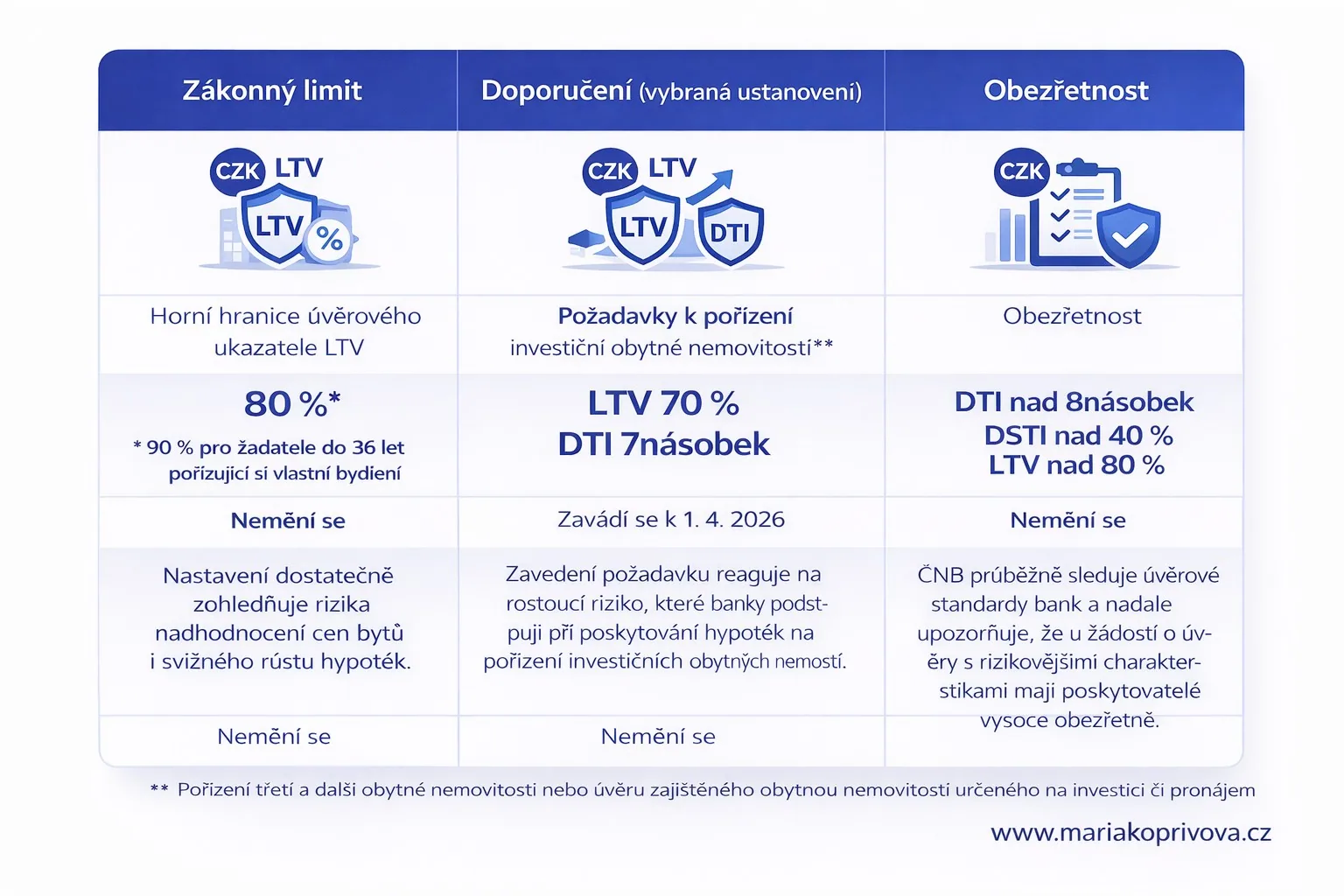
The Czech National Bank recommended that mortgage lenders apply an upper LTV cap of 70% and a DTI limit of 7 for the acquisition of an investment residential property, as well as for loans to acquire a third and each subsequent residential property.
For owner-occupied residential mortgages, the baseline framework remains unchanged:
- the upper LTV limit remains at 80%
- for applicants under 36 years of age, LTV remains at 90%
- DTI and DSTI indicators remain deactivated for owner-occupied housing.
Formally, this is a CNB recommendation rather than an act of parliament. In real estate practice, however, the critical point is that banks have fully adopted this framework into their internal underwriting guidelines. For example, Air Bank has publicly stated since April 1, 2026, that for investment mortgages it will lend a maximum of 70% of property value and the client's total debt burden must not exceed seven times their annual net income.
The CNB explicitly defines an investment mortgage as a mortgage loan provided to acquire a third or subsequent residential property, or to acquire a residential property intended for rental. Consequently, the stricter regime covers not only conventional buy-to-let acquisitions, but also the purchase of a third or subsequent residential unit, even if it is not intended for rental.
2. WHICH LOANS FALL UNDER THE STRICTER REGIME AND WHICH DO NOT
The Czech National Bank interpretation is substantially broader than merely purchasing a completed apartment. The stricter rules with an LTV cap of 70% and DTI of 7 apply to:
- loans to purchase residential property under construction
- loans to purchase residential property with subsequent renovation
- the acquisition of a share in a housing cooperative
- the future purchase of residential property within a development project
- refinancing or refixing a loan combined with an increase in total principal
- the assumption of existing debt secured by residential property.
A crucial difference compared to standard residential mortgages is that these recommendations are not subject to the standard 5% exemption quota that banks can otherwise apply to general LTV, DTI, and DSTI ceilings. The CNB lays this down unequivocally in its methodological guidelines.
Conversely, the stricter investment regime does not apply to:
- refinancing or refixing without an increase in the loan amount
- loans to purchase standalone land without subsequent construction
- loans earmarked exclusively for construction or renovation work itself.
3. HOW BANKS COUNT OWNED PROPERTIES
The new rules are not based on how many active loans you hold. The CNB clearly states that an applicant's number of existing loans is irrelevant to the evaluation. What matters is the actual number of residential properties you already own.
The asset assessment follows these core principles:
- Domestic and foreign properties: All residential properties in the Czech Republic and abroad are counted, including housing cooperative shares. The lender verifies domestic assets via Land Registry records; foreign properties and cooperative shares must be documented by the applicant through a statutory declaration.
- Co-ownership and joint marital property: If an applicant holds at least a 50% share in a residential property, it counts as one full property owned. The same applies to assets held within joint marital property. These fractional shares are not aggregated across different properties; each property is assessed on its own merits.
- Multiple applicants for a single loan: The number of owned residential properties is examined for each co-applicant separately. For the overall evaluation of the loan, the highest figure identified for any one applicant is used.
- Multi-family apartment buildings: If a property is registered in the Land Registry as a single real estate unit but effectively provides housing for multiple households (typically an entire apartment building), it is treated as multiple units for the purposes of the recommendation.
- Recreational properties: Lenders do not need to count weekend cabins and cottages if their genuine character is taken into account. This applies to structures designed for recreation that clearly do not meet permanent residential standards, such as those lacking year-round potable water, electricity, or functional wastewater disposal.
- Properties intended for sale: If an existing property is being sold, it can be excluded from the assessment. A mere statement of intent or a pending draft agreement is insufficient; the bank requires evidence in the form of a signed purchase agreement or a binding preliminary purchase contract.

Read also
NOSARA: AN INVESTMENT PARADISE IN COSTA RICA’S BLUE ZONE – REAL ESTATE, WELLNESS & SUSTAINABLE DEVELOPMENT
4. WORKED EXAMPLE: HOW MUCH CASH YOU NEED TODAY
The shift from the former 80% LTV ceiling to the new 70% LTV limit creates a tangible impact on every investor's capital allocation.
Consider the purchase of an investment apartment priced at CZK 5,000,000:
- Under the previous 80% LTV limit, the bank could lend you CZK 4,000,000, requiring CZK 1,000,000 from your own equity.
- Under the current 70% LTV limit, the maximum possible loan is CZK 3,500,000. The required equity increases to CZK 1,500,000.
- You must therefore have an additional CZK 500,000 ready in liquid cash for the down payment.
Borrowing capacity is also significantly restricted by the DTI indicator capped at 7:
- If an applicant has a net monthly income of CZK 80,000, their net annual income equals CZK 960,000.
- At a DTI cap of 7, the maximum permissible total debt across all credit lines is CZK 6,720,000.
- All existing liabilities count toward this ceiling, meaning an existing primary residence mortgage or consumer credit balances directly reduce the amount the lender can offer for a new investment apartment.
"A successful real estate investment is not about how much money the bank will let you spend at maximum. It is about the ability to anticipate regulatory shifts, accurately calculate total capital requirements, and select an asset that preserves its value under any financial market conditions."
Maria Kopřivová
5. FREQUENTLY ASKED QUESTIONS ABOUT INVESTMENT MORTGAGES (FAQ)
Do the new rules apply to a second apartment that I intend to rent out?
Yes. If you are acquiring a residential property for investment purposes, typically for rental, you fall under the investment regime regardless of whether it is only your second property. The stricter rules are not restricted solely to third properties.
Do these limits apply to a third apartment even if I do not plan to rent it out?
Yes. For a third and any subsequent residential property, the declared purchase objective is irrelevant; the total count of owned properties is decisive. The regime applies even if the apartment is acquired as a family reserve or future housing for your children.
Does it depend on the number of mortgages or the number of properties?
It depends exclusively on the number of residential properties owned. The number of active credit facilities plays no role.
Do foreign properties and cooperative apartments count toward the threshold?
Yes. Units located both domestically and abroad are included, as are shares in housing cooperatives.
How does a lender view a fractional ownership share?
If you own an interest of at least 50% in a residential property, the bank records it as one full property.
What happens if partners apply for a loan jointly?
When multiple applicants apply, owned properties are evaluated for each partner individually, and the highest figure determined for either co-applicant is applied to the application.
Does a property currently being sold stop counting?
A mere intention to sell is not enough. To exclude the property from underwriting, you must submit a signed, binding purchase agreement or preliminary purchase contract to the lender.
Can a recreational cottage or cabin be exempted?
Yes, provided the building clearly does not meet permanent residential standards and lacks year-round water supply, electricity, or standard wastewater infrastructure.
Do these rules apply to development projects and apartments requiring renovation?
Yes. The stricter parameters govern acquisitions of units under construction, future purchase contracts in development schemes, and property purchases earmarked for subsequent renovation.
How does this affect mortgage refinancing?
Standard refinancing or refixing without an increase in principal is exempt from the new rules. However, if you increase the total loan amount, the 70% LTV and DTI 7 limits cannot be avoided.
Can lenders grant standard exemptions from these caps?
No. The customary 5% exemption quota that banks use for standard residential mortgages does not apply to these CNB recommendations.
6. KEY TERMS: HOW THE REGULATION WORKS
To help you navigate banking and underwriting terminology, here is an overview of the core regulatory mechanisms:
- Investment mortgage: A loan secured by residential property used to acquire real estate for rental purposes, or to purchase a third and any subsequent residential property for the borrower.
- CNB statutory authority: Since 2021, the Czech National Bank has held statutory authority to set binding upper limits for LTV, DTI, and DSTI indicators across the entire banking sector.
- CNB Bank Board: The central bank's governing board reviews financial stability twice a year, typically in spring and autumn. Based on systemic risk trends, it decides whether to introduce, adjust, or tighten lending macroprudential tools.
- Countercyclical capital buffer (CCyB): A macroprudential instrument designed to reinforce banking sector resilience during periods of rapid credit expansion, ensuring lenders hold sufficient capital reserves for potential economic downturns.
- LTV (loan-to-value): The ratio between the mortgage loan amount and the appraised collateral value of the property. At 70% LTV, the bank lends a maximum of 70% of the property value, requiring 30% from your own equity.
- DTI (debt-to-income): The ratio of the applicant's total debt to their net annual income. It encompasses the aggregate balance of all existing loans and debt facilities.
- DSTI (debt-service-to-income): The percentage share of monthly debt service payments relative to the applicant's net monthly income, reflecting the ongoing pressure of regular loan installments on the household budget.
PLANNING TO BUY OR SELL AN INVESTMENT PROPERTY?
Optimal timing and capital structuring determine the total return on your investment. I evaluate every property comprehensively: from technical condition and location fundamentals to realistic yield potential and bank financing constraints.
Likewise, when selling an investment apartment or multi-family building, it is vital to target verified, high-net-worth buyers with sufficient equity who are not constrained by the new regulatory framework.
I would be pleased to review your specific scenario with you without obligation, assess your buying or selling options, and propose a sound strategy tailored to current market conditions. Your information is managed securely in accordance with my principles for personal data processing.
Simply complete the brief form directly below this article. I will get in touch with you to arrange an in-person or online consultation.

Complimentary personal consultation
Facing a similar situation? Let's discuss it.
Every property and every sale is different. Write me a few lines and I will suggest a concrete next step.
- I reply personally, never an assistant or call centre
- Discretion and confidentiality from the first word
- Concrete recommendations instead of generic advice

Author
Maria Kopřivová
Real Estate Investment Partner. Prague and Costa Rica, off-market transactions and investment property.